
Is There Still a “Best” Time to Sell a Home?

For decades, the answer felt simple:
List in the spring. Avoid the holidays.
That advice wasn’t wrong—but it was rooted in a market that no longer exists.
In today’s housing market, especially in older-home neighborhoods like Pasadena, Altadena, Silver Lake, Los Feliz, and Eagle Rock, timing alone no longer determines success. Preparation, pricing, and clarity now matter far more than the month on the calendar.
Is There Still a “Best” Time to Sell a Home?
In today’s market, the short answer is no—not in the traditional sense.
While spring remains slightly more active, the data shows that sellers are no longer rewarded simply for waiting for the “right” season. Homes that perform well do so because they are well prepared and realistically priced—not because they were listed in a particular month.
Seasonality still exists. Its influence has simply diminished.
What the Data Shows
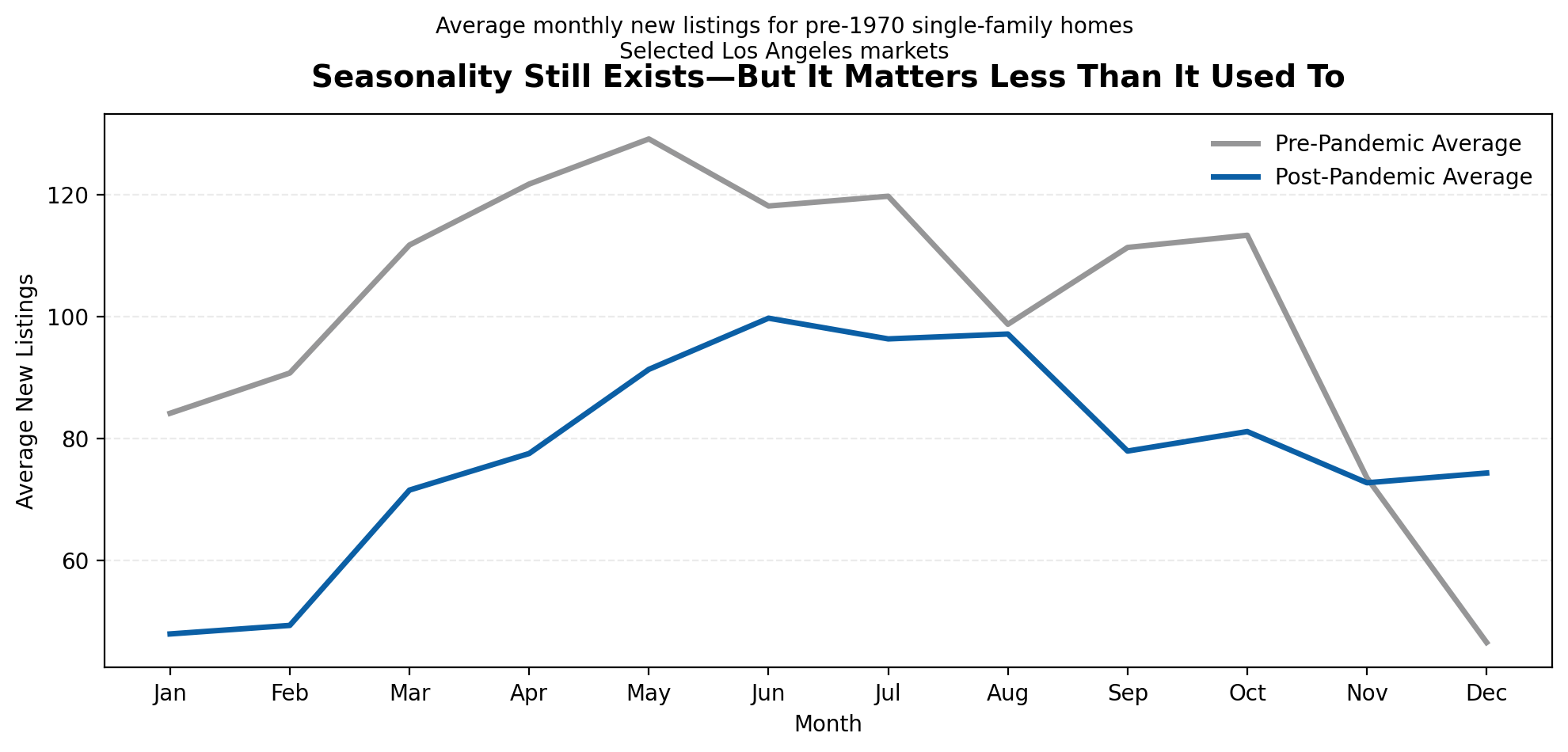
Looking at listing and sales data for pre-1970 single-family homes across my core markets, a clear shift emerges when comparing pre-pandemic and post-pandemic patterns.
Historically, the Los Angeles market followed a predictable rhythm:
New listings surged in spring
Activity peaked in early summer
Fall slowed significantly
December was effectively dormant
That pattern was especially pronounced before 2020. Sellers who missed the spring window often waited an entire year for another clean opportunity.
Post-pandemic, that rhythm has flattened.
While spring still sees more listings, the data shows that meaningful activity now extends deeper into summer, fall, and even early winter. December is quieter—but it is no longer inactive.
The gap between strong and weak months has narrowed.
That distinction matters.
Why the Old Rules Don’t Apply the Same Way
Several structural changes have reshaped how—and when—homes sell:
Inventory remains constrained, even as listings rise
Buyers are more deliberate and less reactive
Interest rates influence when buyers act, not just if
Condition and pricing now outweigh seasonal momentum
The market is no longer driven by urgency alone. It is driven by confidence.
And confidence comes from information.
The New “Best” Time to Sell a Home
If there is a new rule, it’s this:
The best time to sell a home is when the property—and the strategy—are ready.
Homes that succeed today tend to share three characteristics.
1. Preparation Matters More Than Ever
Deferred maintenance is no longer something buyers quietly overlook.
Mechanical systems, roofing, plumbing, electrical, drainage, and overall condition play a central role in how a home is evaluated—and whether buyers feel comfortable moving forward.
A well-prepared home does not need to be perfect. But it does need to be understood.
Pre-inspections, proactive repairs, and clear documentation remove uncertainty, which is the single biggest deal killer in today’s market.
2. Realistic Pricing Creates Momentum
The era of pricing “aspirationally” and letting the market sort it out has largely ended.
Today’s buyers are informed, analytical, and quick to disengage when pricing does not align with condition or recent sales. Overpriced homes don’t just sit—they become stigmatized.
Correct pricing at launch creates momentum. Chasing the market erodes it.
3. Clear Communication Builds Confidence
Buyers are asking better questions than they used to:
How old are the major systems?
What’s been updated—and what hasn’t?
What does long-term ownership realistically look like here?
Listings that answer those questions clearly outperform those that rely on aesthetics alone.
In older-home markets like Pasadena, Altadena, Silver Lake, Los Feliz, and Eagle Rock—where character comes with complexity—clarity is not a liability. It’s a competitive advantage.
Does Seasonality Still Matter?
Yes, but it is no longer decisive.
Spring may offer slightly more buyer activity, but it will not rescue an unprepared or mispriced listing. Conversely, a well-positioned home can perform strongly outside traditional “peak” months because it stands out in a thinner field.
The market no longer rewards waiting for the perfect month.
It rewards launching when the fundamentals are right.
The Bottom Line for Sellers
Bottom line: In today’s market, sellers are rewarded for preparation—not for waiting on the calendar.
If you’re considering selling, the more important question is no longer when to list, but whether your home is positioned correctly for today’s buyer.
That means understanding condition, pricing realistically, and communicating clearly.
If you’re weighing a sale in 2026 and want an honest assessment of how your property fits into the current market—seasonality, condition, pricing, and strategy included—I’m always happy to talk it through. No pressure, no sales pitch—just a clear look at the data and your options.
Michael Robleto
PreWar & MidCentury Specialist
Compass
213-595-4720
michael.robleto@compass.com
About The Author
Michael Robleto is a Los Angeles–based REALTOR® specializing in historic, pre-war, and mid-century residential properties, with a focus on Pasadena, Altadena, and Eastside neighborhoods including Los Feliz, Silver Lake, Eagle Rock, and Mount Washington.
Known for his deep understanding of older homes and residential construction, Michael helps clients navigate the complexities of historic properties—from aging mechanical systems to long-term ownership considerations. His approach combines data-driven guidance with thoughtful, modern marketing, allowing clients to make informed decisions in changing markets.
A California native and the son of a contractor, Michael grew up in an older bungalow and has spent more than two decades studying Southern California’s residential architecture. He currently serves as Chairman of the Board of Pasadena Heritage and writes about homeownership strategy, architecture, and market dynamics through his Bungalow Agent platform.